

Anyone evaluating shared micromobility for a property eventually asks the bike-versus-scooter question. The honest answer is that they solve overlapping problems but with very different cost structures, demographics, and operational footprints. This article walks through the trade-offs operator-to-operator, so you can make the call based on your actual property, not vendor pitch decks.
Trip distance and terrain — the variable that decides most cases
Scooters dominate in the half-mile to two-mile range on flat or gently rolling terrain. E-bikes extend that range comfortably to three to five miles and handle hills that would slow a scooter to a crawl.
Match the asset to your geography:
- Tight, flat campuses (under 1.5 miles point-to-point): scooters win. Faster mounting, smaller footprint, easier for casual users.
- Larger campuses or sprawling business parks (1.5-4 miles): e-bikes win. Better at sustained speed, more comfortable for longer rides.
- Hilly terrain (5%+ grade): e-bikes only. Scooter motors struggle and battery drains 2-3x faster.
- Mixed paved and gravel: e-bikes handle it; scooter small wheels do not.
The Power Design corporate campus in St. Petersburg is the classic scooter use case — flat, dense, half-mile typical trip. A sprawling life-sciences campus with quarter-mile-long internal roads on rolling terrain might be a better e-bike candidate.
Demographics: who actually uses each one
Adoption profiles are different. Scooters skew younger and more casual. E-bikes attract a slightly older, more confident-cyclist user base. Both work for general worker populations, but the lift-off speed differs.
Scooters
- Lower learning curve — most riders are confident within seconds
- Strong appeal to riders who don't bike
- Highly impulsive use — short notice, short trip
- Less appealing in business attire (skirts, dresses, suits) but workable
E-bikes
- Steeper barrier — requires bike comfort and helmet etiquette
- Strong appeal to existing cyclists
- More planned, longer trips
- Easier in business attire, especially with step-through frames
Cost structure: capex, opex, and per-ride economics
Both fleet types have similar long-run economics on the right deployment, but the cost curves are shaped differently.
Capital cost per unit
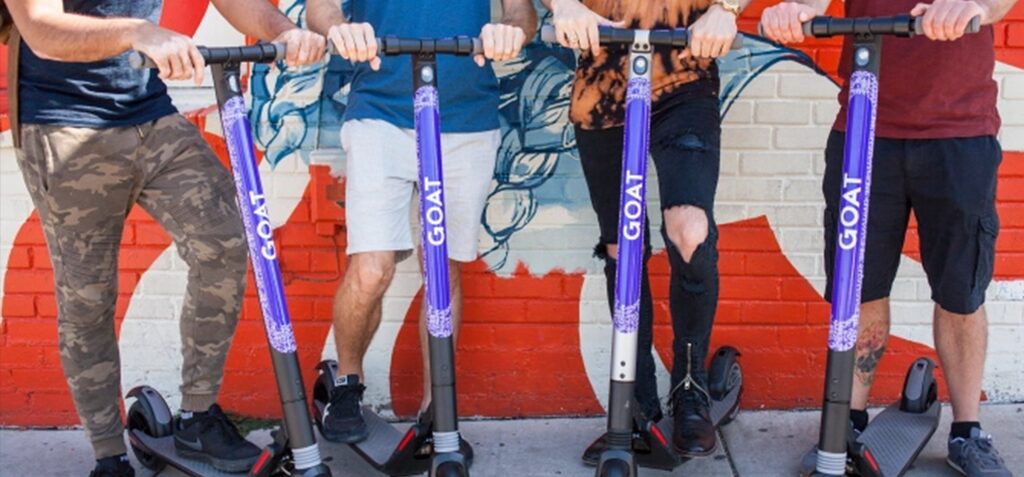
Fleet-grade e-scooters run roughly $1,200-$1,800 per unit new. Pre-owned fleet inventory like Segway Max 2.3 runs significantly less. Fleet-grade e-bikes typically run $1,800-$3,200 per unit, with cargo and high-step models toward the upper end. A 30-unit scooter fleet starts at meaningfully lower capital exposure than the equivalent bike fleet.
Maintenance hours per ride
Scooters have fewer moving parts — no gears, no chain, no drivetrain. The trade-off is that small wheels are more sensitive to potholes and curbs. E-bikes have more drivetrain maintenance (chain wear, derailleur tuning, brake pad swaps on more powerful disc systems) but tougher overall structure.
In practice, scooters average roughly 1 hour of preventive maintenance per unit per month; e-bikes run closer to 1.5 hours. Both should budget for one major rebuild per unit per year.
Battery and charging
Scooters have smaller batteries (typically 400-650 Wh) which charge fast and swap easily on modern designs. E-bike batteries (500-700 Wh) take longer to charge and weigh more, making swap operations slower. For a property without backroom space for charging, scooters with swap batteries are typically simpler.
Property fit: matching asset to deployment type
Corporate campuses
Scooters are usually the right answer. Dense building layouts, predictable peaks, and short trips favor faster mount-up and smaller footprint. The exception: sprawling life sciences or industrial campuses with longer internal distances.
Hotels and resorts
Both work, often together. Scooters for quick on-property trips and beach runs; e-bikes for guests heading farther afield, especially at coastal or destination resorts. Resorts that offer both report 15-25% higher amenity satisfaction scores in guest surveys.
Master-planned residential
Lean toward e-bikes for larger communities (over 200 acres) and toward scooters for tighter ones. Bike fleets tend to attract residents commuting to amenity centers; scooters dominate quick errands and visits.
Mixed-use developments
Often both. The retail/restaurant tenants benefit from short-trip scooter access; the office tenants want longer-range bike options for client trips.
Storage and footprint
A 30-unit scooter fleet can be staged in a 200 sq ft area at the property. A 30-unit bike fleet typically needs 600-800 sq ft, plus reinforced anchoring or a dedicated rack system. Properties with limited back-of-house space often default to scooters for this reason alone.
Charging room footprint is similar — both can be served by a 100 sq ft secured room with proper ventilation and a fire-rated charging station.
Helmet rules and risk profile
This is one area where bikes and scooters diverge meaningfully. Scooter injury rates are statistically higher per ride, driven by small-wheel instability and a less-confident user base. Insurance premiums on a scooter fleet typically run modestly higher than the equivalent e-bike fleet.
However, scooters are easier to govern speeds on (most fleet platforms cap at 15 mph by default and can geofence to 8 mph in pedestrian zones), which materially reduces the severity tail. Bikes are harder to speed-cap once the rider is pedaling.
Both fleet types should require a helmet acknowledgment in-app, but on-site helmet provision and storage favors bikes (riders accept it as normal) over scooters (riders treat helmets as optional even when offered).
The right answer for most operators
If you're launching your first fleet on a flat, dense campus or hospitality property, start with scooters. Lower capital, simpler ops, faster adoption, more familiar UX. Layer in e-bikes once you've proven utilization and have data on the trip lengths your riders actually want. Many of the strongest deployments end up running both — but they earned the second fleet by knowing exactly what gap it would fill.
Ready to launch your fleet?
If you're sizing the opportunity, run the numbers in our revenue calculator — plug in your own scooter count, ride volume, and pricing to project monthly gross. To see what's available right now, browse our pre-owned fleets (Segway Max 2.3 in great condition, 10-unit minimum) or email hello@ridegoat.com with your situation and we'll send a tailored proposal within one business day.