
Most corporate scooter fleets fail not because the math is wrong, not because the hardware is bad, but because nobody told the riders. A new fleet on a corporate campus is a new behavior for thousands of people — and getting humans to change daily routines requires more than a launch email. This article walks through the launch and adoption playbook we use to take a 30-50 unit deployment from zero to 4+ rides per scooter per day inside the first 90 days.
The launch arc: 4 phases, 90 days
Adoption follows a predictable curve. Plan in four phases instead of treating launch as a single event.
Phase 1: Pre-launch (weeks -2 to 0)
Build anticipation before the scooters arrive. The goal here isn't ride volume — it's awareness and reduced friction at the moment of truth (when a worker first sees a scooter and wonders "is this for me?").
- Send 2-3 staggered all-hands emails, each shorter than the last
- Place posters at coffee stations, elevators, and parking garage entries showing the scooter and the QR code
- Pre-load app with employee SSO so signup is one tap
- Brief the front desk, security, and facilities teams — they will be asked questions
Phase 2: Launch week (days 1-7)
The first week determines the year. Bring a launch crew to the property for two to three days, run live demo loops, hand out swag, and let people try a scooter without committing to anything.
- Set up a branded launch table near the most-trafficked entrance
- Offer a free first ride with no payment captured at signup
- Walk people through the unlock flow in person
- Photograph happy first riders for the property's internal Slack and LinkedIn
Phase 3: Habit formation (weeks 2-6)
The riders who tried it in week 1 either become regulars or fade. Your job in this phase is to reduce friction and add reasons to ride.
- Set up "speed lanes" or scooter-friendly parking corrals at each major destination
- Run a "5 rides in 5 days" challenge with small rewards
- Identify and celebrate "early adopter" employees publicly — they become your evangelists
- Push targeted reminders to riders who tried once and didn't return
Phase 4: Steady state (weeks 7-12+)
Adoption stabilizes. Now you optimize for ride frequency per active rider rather than new signups.
- Monthly "rider of the month" recognition
- Add new use cases (e.g., scooter access to nearby off-property amenities)
- Use ride data to suggest improvements to property layout or shuttle schedules
- Quarterly adoption report to the property partner — gives them ammunition for renewal
The signage playbook
Riders need to know three things: that the scooters exist, how to start a ride, and where they're allowed to park. Solve those three with intentional signage and you've removed the bulk of the friction.
- Wayfinding: arrow signs at building entrances pointing to the nearest scooter cluster
- QR-to-app: visible QR codes at every scooter cluster and on the scooters themselves
- Park-here graphics: ground decals at corral zones reduce sidewalk dumping by 60%+
- Etiquette posters: a one-page "how to be a good rider" near elevators and break rooms
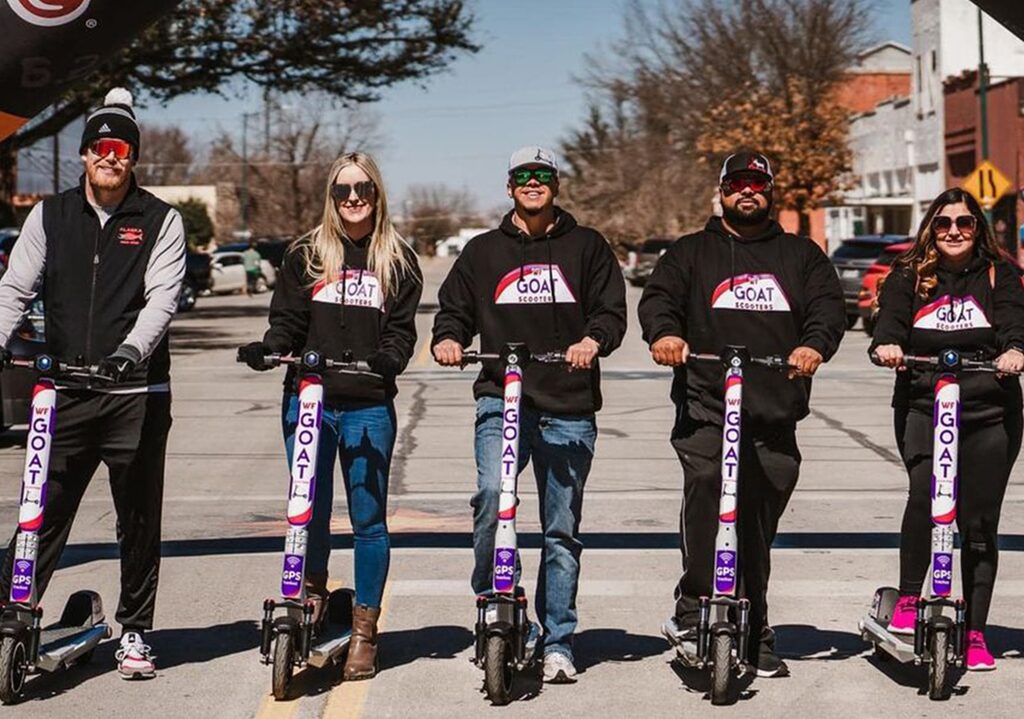
Goat-branded Aike units are intentionally purple because high-contrast color draws the eye. The scooter itself is the most effective marketing asset on the property.
Referral loops that actually trigger
On a corporate campus, the most powerful adoption signal is seeing a coworker on a scooter. You can engineer that effect with a few simple structures:

- Free-ride referral codes: "share with a coworker, you both get a free ride"
- Team challenges: "first department to log 100 rides wins a catered lunch"
- Weekly leaderboards: visible in Slack or company intranet, gentle gamification
Don't overdo gamification. Adults working in offices respond to status and convenience, not to badges. Light touches.
Channels that work, channels that don't
What works:
- The first 30 seconds of an all-hands meeting or town hall
- The internal Slack #general or #announcements
- Physical signage in elevators and break rooms
- Email with a video, not a paragraph
- Word of mouth from launch-day participants
What doesn't:
- Long internal newsletters that nobody opens
- Standalone microsites the property has to publish
- Static posters that don't change for 6 months
Numbers that tell you it's working
Track these weekly for the first 90 days, then monthly thereafter:
- Active riders / total potential riders: aim for 30%+ in 90 days, 50%+ in 6 months
- Rides per active rider per week: healthy is 4+
- Repeat rate: percentage of first-time riders who ride a second time within 14 days. Target 60%+
- Rides per scooter per day: the master KPI. 4+ is healthy, 6+ is excellent
- Net Promoter Score: survey active riders quarterly
If the repeat rate is below 40%, your problem is product or experience (slow unlock, dead battery, too short a trip distance) — not marketing. Fix the experience first; more marketing on a bad product just accelerates churn.
Co-marketing with the property partner
Your property partner has marketing assets you don't: the building's lobby screen, the welcome packet for new hires, the tenant Slack, the front desk staff. Make the fleet a co-branded amenity, not an outside service. The Power Design deployment in St. Petersburg is positioned as a Power Design benefit powered by Ride Goat — that framing makes the property invested in adoption and accelerates internal champion recruitment.
Negotiate co-marketing rights into your master service agreement up front: lobby screen access, internal newsletter inclusion, new-hire packet inclusion, branding on signage. These are zero-cost rider acquisition channels with much higher trust than anything you could do alone.
Ready to launch your fleet?
If you're sizing the opportunity, run the numbers in our revenue calculator — plug in your own scooter count, ride volume, and pricing to project monthly gross. To see what's available right now, browse our pre-owned fleets (Segway Max 2.3 in great condition, 10-unit minimum) or email hello@ridegoat.com with your situation and we'll send a tailored proposal within one business day.