

Insurance is the part of fleet operations where new operators most often cut corners, and it's also where one bad incident can erase a year of profits. The good news: scooter fleet insurance is well-developed at this point, premiums are reasonable for operators with documented procedures, and most landowner partners will tell you exactly what coverage they need. This guide is a practical walkthrough of what to buy, how to structure your waivers, and the operational hygiene that keeps your loss ratio low. None of this is legal advice — talk to a lawyer and a broker before you sign anything.
The four policies that make up a complete fleet insurance stack
Most fleet operators end up with four overlapping policies. They're not optional — most property partners will require evidence of all four before they let you on site.
Commercial general liability (CGL)
This is the core policy that responds to third-party bodily injury and property damage. Standard limits are $1M per occurrence / $2M aggregate, and many landowners now require $2M / $4M for fleets above 25 units. Premiums for a 30-50 unit fleet typically run $4,000-$10,000 annually, depending on location and operating model.
Product liability
Often bundled inside CGL, but worth confirming. This responds when a defective scooter component causes injury — a brake failure, a battery thermal event, a stem fracture. Make sure your CGL has explicit product liability language, especially if you operate pre-owned hardware.
Commercial auto
Required if you operate any vehicle (van, truck, golf cart) for rebalancing or service. Often overlooked by first-time operators using personal vehicles, which is a coverage gap that voids personal auto policies the moment you're on the clock.
Workers' compensation
Mandatory in nearly every state if you have employees, including part-time field techs. Even a single 1099 contractor can trigger requirements depending on state law. Get a Pay-As-You-Go policy if your headcount fluctuates.
Optional but increasingly common: cyber liability (covers data breaches of your rider database) and umbrella coverage that extends limits across the stack.
Rider waivers: what actually holds up
A rider waiver is one of your most important risk controls, but only if it's drafted properly and executed properly. The court tests across most US jurisdictions look for three things:
- Conspicuousness: the waiver can't be buried in a 40-page TOS. Use a separate signature, a checkbox with prominent language, or a dedicated waiver screen.
- Specific risks: generic "I waive all claims" language is weakest. Enumerate the specific risks: collisions, road hazards, mechanical failure, third-party negligence.
- Affirmative acknowledgment: "By tapping Continue, I acknowledge..." is stronger than passive consent.
Even a strong waiver doesn't shield you from gross negligence — meaning if you knowingly deploy a scooter with a broken brake, the waiver does nothing. It's a layer of defense, not a substitute for safe operations. Many operators also build in a one-time helmet acknowledgment, mandatory ID verification for first-time riders, and a built-in tutorial screen on first ride.
The "additional insured" requirement
Almost every property owner — corporate campus, hotel, HOA — will require you to name them as an additional insured on your CGL policy and provide a Certificate of Insurance (COI) before you can deploy. This shifts liability to your policy if a rider injures someone or damages property on the premises.
What to expect on a typical COI request:
- The property owner named as additional insured (sometimes also their property manager and parent entity)
- Waiver of subrogation in favor of the property owner
- Primary and non-contributory language — your policy pays first, before theirs
- 30-day notice of cancellation (sometimes 10-day)
- Proof of workers' comp and auto coverage
Build a relationship with a broker who has issued COIs for at least one other shared mobility client. They'll know the standard endorsements and won't charge you per certificate (which can add up quickly across 10+ properties).
Operational habits that keep premiums low
Loss ratio drives premium. If your fleet generates frequent claims, your renewal will hurt. The single biggest driver of claims is rider injury from mechanical failure, and the single biggest driver of mechanical failure is poor maintenance discipline. Tight ops practices feed directly into low premiums.
Six habits that insurance underwriters love:
- Documented preventive maintenance schedule with timestamped records
- In-app helmet acknowledgment and a 5-question pre-ride safety quiz on first use
- Geofenced max-speed zones near pedestrian-heavy areas (cap at 8-10 mph)
- End-of-ride parking photo confirmation to deter sidewalk dumping
- Documented incident response procedure with photos, witness statements, and police reports where applicable
- Annual safety training for all field staff with sign-off records
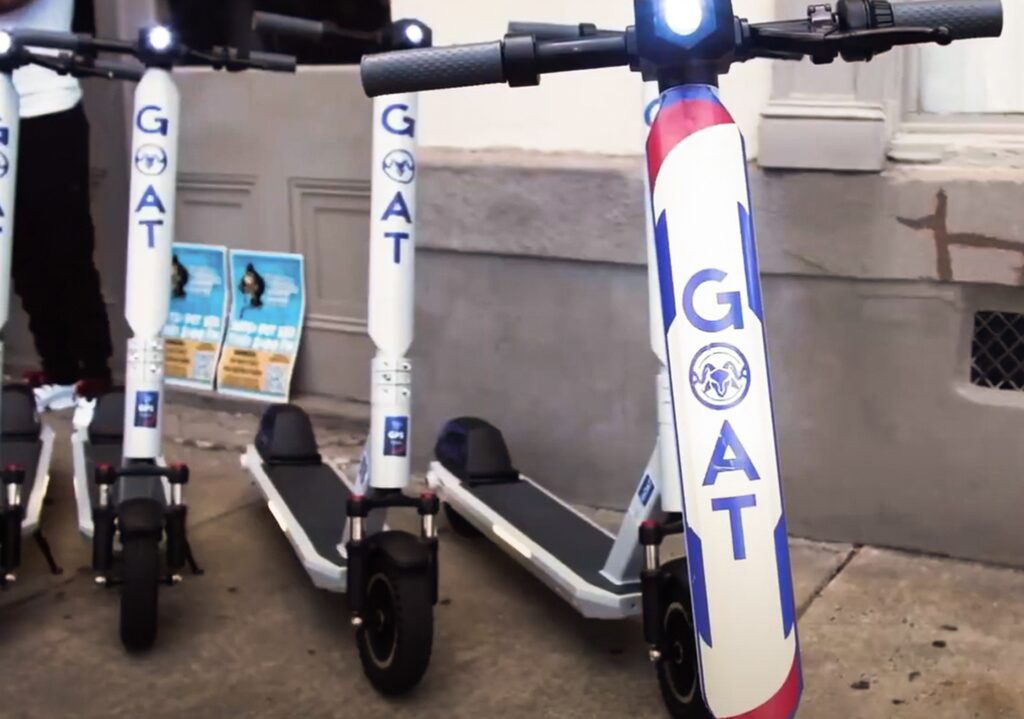
Goat-branded Aike units help on the hardware side: dual brakes mean no single point of failure on stopping, dual kickstands reduce tip-over claims, and the swappable-battery design eliminates the in-field charging risks that have caused thermal events on competing fleets.
Common claim scenarios and how to be ready
Rider crashes into a pedestrian
Most likely scenario. Your CGL responds. The defense is your waiver, your geofenced speed limits, and the rider's own choices. Document everything: time, location, witness contact info, photos.
Rider injures themselves alone
The waiver is your primary defense. If the scooter is mechanically sound (per your maintenance log), most jurisdictions enforce the waiver.
Property damage to a third party
Common at hotels and condos — a rider crashes into a parked car. CGL responds, your loss-runs go up, premiums adjust at renewal.
Battery thermal event in storage
Rare but high-severity. Your property liability policy on the storage location should respond, and your product liability backstops it. Mitigate with proper charging room ventilation and approved chargers only.
The contract clause that matters most with property partners
Beyond insurance, your master service agreement with the property owner needs an indemnification clause that's mutual and capped. Operators who sign one-way, uncapped indemnifications expose themselves to bankruptcy-level risk. A standard structure: each party indemnifies the other for its own negligence, with caps at insured limits and carve-outs for gross negligence and willful misconduct. Pay a lawyer to draft your master template once. You'll use it dozens of times.
Ready to launch your fleet?
If you're sizing the opportunity, run the numbers in our revenue calculator — plug in your own scooter count, ride volume, and pricing to project monthly gross. To see what's available right now, browse our pre-owned fleets (Segway Max 2.3 in great condition, 10-unit minimum) or email hello@ridegoat.com with your situation and we'll send a tailored proposal within one business day.